This review contains spoilers. You have been warned.
To cut a long story short, I do recommend Octopath Traveler 2. It is a fine game. I do not recommend immediately playing it after the original game. These in-depth story-rich JRPGs need you to take a break so you have time to digest them.
But I digress.
My review of the original title was a 3500-word monstrosity that deconstructed the entire game from the ground up. Buried in that monster of a piece was overwhelming praise for a game which did nothing new but assembled its component elements with great skill. It was incredibly respectful of the pantheon of JRPGs that had come before it, too.
I was so captured by quality the first game, I picked up the sequel immediately.
This was a mistake.
Playing a JRPG is like eating dinner. Unless you have a particularly large stomach, or you ate at an extremely upscale restaurants with microscopic portions, it is generally a bad idea to eat dinner twice. You were already full, and now you feel sick.
It was around the 80-hour mark that I realised the error of my ways. Fatigue set in quickly, and I blew through the last handful of chapters to be free of the gilded cage I had built for myself. This is not the fault of Octopath Traveler 2, but nevertheless, it will bear the sins of my poor judgement.
Even accounting for this fatigue, OC2 does not represent a significant step forward. I am confident in saying that it is a fine game in isolation, but a middling sequel.
I adored almost every component of the original game. It was mechanically complete, story rich, and visually stunning. Being a double-a game that no-one cared about gave the development team room to polish the experience to a mirror sheen, and the results speak for themselves.
This set the bar high for the sequel. It is not enough for the second title to be a good product; it should deliver an improved experience over the original title. Octopath Traveler 2 does not succeed in this aim.
To restate my position:
Do I like OC2? Yes.
Should you play it? Yes.
Is it a good sequel? No.
Plenty of games are fantastic stand-alone experiences and sequels. Octopath Traveler 2 isn’t one of them. It’s more like an expansion pack.
In the game’s defence, it is very difficult to improve on perfection.
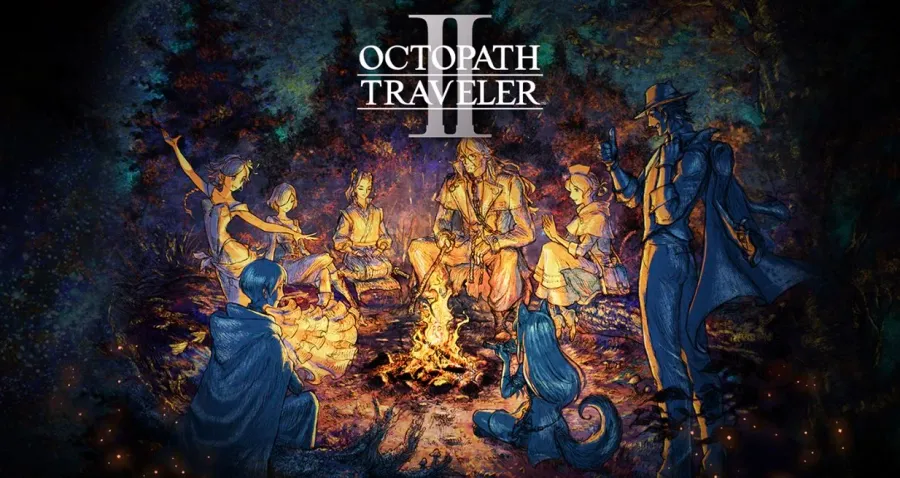
For what it’s worth, OC2 does look better than the original game. Something I did not believe was possible. The game’s environments are designed with love, care, and craft, and are a visual treat. Sometimes pixel art is seen as a visual shorthand for putting in less effort – but it’s games like Octopath Traveler that prove pixel art, when executed correctly, has its own charm which cannot be replicated by hyper-realistic triple-a titles.
Routes are full of travellers, landmarks, and curiosities. Towns and cities feel sprawling and organic, filled to bursting point with points of interest, and inhabitants to interact with. It gives the world a tremendous sense of life as you adventure through it.
My favourite biome, the Leaflands, is simply stunning – words fail to describe it. Bright, vibrant greens and browns, bubbly upbeat music (even at night – more on that later) – it’s an incredibly immersive experience.
This all contrasts very favourably with other RPGs and JRPGs, which can feel lifeless by comparison - looking at you, Breath of the Wild. Both games give me the feeling of on a warm blanket, and I feel comfortable and relaxed when playing.
The designers wanted you to experience as much of each environment as they could, so they send you back to settlements in each biome. This is an improvement on the original game, where you would not stop at any town more than twice, and never the beginning settlements. Sending the player back to areas previously explored but with new story beats makes sense, altering the lens through which you view an environment.
Furthermore, I enjoy the game taking the decision to give equal weighting to each biome. I enjoy grasslands, jungles and lush green pastures. It is a common trope to move past these sorts of environments as the stakes increase, leaving behind the beauty inherent in these zones. The designers understand the of cost cutting these environments out over the course of the story, so they don’t.
Speaking of the story, the writing has improved. It’s not Pulitzer material all the way down, but it is a marked improvement on the first game, where several stories were busts – thanks, Tressa, very cool. Every path in OC2 has compelling story beats, and there’s more diamonds than rocks.
However, the scales have tilted in favour of the grim and miserable. There are bright spots thanks to characters like Agnea the Dancer and Partitio the Merchant, but more than half of the stories have a harder edge to them. Castti the Apothecary is the poster child for the shift, her story having no shortage of confronting and emotional elements – one of which genuinely made me tear up.
Additionally, there are four secondary stories which feature a pairing of two characters. These “crossed paths” serve the dual purpose of supplementing character development and laying the foundation for the post-game content.
They are all bangers. Each storyline builds a sense of cohesion between the travellers that was missing in the first game. I enjoyed them all so much that I can’t pick a favourite. They’re also much lighter in tone and help to break up the dark and serious tones featured elsewhere.
Having established the game looks nice and has improved narrative elements, let’s talk about where the game falls short – gameplay.
As I mentioned earlier, it is difficult to iterate on perfection. I don’t want to repeat myself here, so if you want to read through my deconstruction of the original game’s combat to a frankly unnecessary degree, you can read it here.
The cliff’s notes are there’s no mechanical changes. Enemies have shields, weaknesses, boss fights change forms, the system is more about ebb and flow than brute force. No notes here, perfect.
Jobs are still here, distributed by guilds instead of shrines, except for the advanced jobs, which are hidden behind a series of different in-game events. Guilds now grant you additional licences so several characters can have the same job, which is nice quality of life change when you want to change your party around and need to juggle both their equipment and their job.
Shrines are still in the game, but their function has changed. Now you need to bring the character whose class matches the shrine to receive a bonus EX-skill. These are powerful and give you more options when building a party. You also receive a second EX-skill upon completion of the character’s path.
Octopath Traveler 2 has a greater focus on characters and their innate abilities, as opposed to the skills of their class. To this end, several characters have seen improvements to their in-combat abilities.
Ochette the Hunter now has a chance to automatically capture eligible monsters. In addition, monsters don’t abandon you, so series of monsters with strong utility goes a long way. If you don’t want the monster, it can be turned it into an item. These three changes turn Provoke from something you never used to the cornerstone of Ochette’s role in your party.
When recruiting an NPC with Agnea’s path action, the NPC you recruit bestows an additional benefit in combat when you use a dance skill. Incredibly useful and makes Agnea an all-star – pumping out damage and supporting her party simultaneously.
If Hikari the Warrior defeats someone with his path action, he learns a combat skill.
Path actions now change in function. Depending on the time of day, a character can use one of two path actions. As an example, Throne the Thief can steal from NPCs during the day. At night, she can perform an ambush and knock an eligible target unconscious. There is a button to shift the time from day to night too, so you are never stuck waiting.
For those playing at home, there are 16 different path actions. They can be broken down to the type of action (noble or rogue) outcome (steal, inquire, incapacitate, recruit) and the time of day as mentioned above.
Some NPCs only appear during the day or night, too, requiring one of the two characters who can perform the path action in that time slot.
Some combination of path action and combat ability remain garbage and not worth your time – Temenos the Cleric and Partitio the Merchant are both stuck with the original (and bad) versions of the recruit archetype, which is not rewarding to use. They are useful in their other ways which is a testament to the depth on display here.
A criticism of the original title was that Path Actions were almost never needed to advance the game state. It appears a significant amount of effort has been put into designing storylines that actively require the player to use a path action.
I want to single out Hikari the Warrior here – his story requires several characters, including at least one chapter boss, to be defeated in a challenge, which gives Hikari a unique skill he cannot get anywhere else. This is both a mechanical and flavour home run, reminding the player of all the enemies that have been defeated on his quest to take back the Throne of Ku.
Enemies are also stronger at night – unless you have Temenos the Cleric, who debuffs your enemies, and Throne the Thief, who buffs your party during night encounters. Then your party becomes much stronger, further watering down the challenge of regular enemy encounters.
Our last mechanic is Latent Power. If you’ve played Final Fantasy X, you know how this works. Each character has a gauge which fills when they break shields and take damage. When the gauge fills completely it can be expended for a unique skill or ability augment.
Sometimes it’s a series of powerful attacks, a buff to the character’s skill, or allowing a single-target spell to affect all your party members.
Eventually, the right combination of skills, latent power, and class abilities lets you clear encounters on the first turn. That caused the game to blur together. Outside of the final post-game boss fight, I felt the challenge audibly slop out of the game.
None of changes are bad. However, holistically, it doesn’t reflect a significant step forward. Nothing here deepens the combat experience. Indeed, once you start getting skills like Full Power and Boost Start, regular encounters become a series of nails to hammer in, and all recollection of the original game’s complexity is lost.
Whilst I’m on the hate train, I do not like the decision to put advanced jobs behind obtuse encounters needed to be looked up in a guide, which are entirely possible to miss over the course of a playthrough. Octopath Traveler does not thrive by confusing and misdirecting the player. It is at its stronges when it challenges a player with a tough boss encounter and asks them to climb the wall.
At least, until you get to the post-game.
In my review of the Golden Sun games, I was highly critical of the decision to allow bosses to dispel buffs and debuffs. I noted that taking away a player’s options did not improve the combat experience.
Now, during my playthrough of both Octopath Traveler games, none of the bosses had the ability to remove buffs – the final optional boss can remove these effects.
Why? What depth does that add? In my opinion, nothing. If anything, it takes the established play pattern and throws it in the bin. It is lazy design, in a game that has tremendous depth.
So where does this leave us?
To take 2000 words and reduce them to a soundbyte, Octopath Traveler 2 is a fine game. But coming from the heights of the original game, lightning has not struck twice. There are better visuals, different characters, and marginal additional gameplay elements. That is not enough for a sequel to stand on.
With enough time to digest the original game, I think there would be more joy to be had. Even then, I remain unconvinced of its merits – apart from the outstanding visual fidelity, that is.
We shall see what OC Zero has to say for itself – in a little while.
Catch you next time,
Vulkan
Critical Information Summary
Review Platform: Nintendo Switch
Developer: Square Enix Business Division 11, Acquire
Publisher: Square Enix
Cost (At Time of Publish): $110 (Switch 2 Price)
Did you like this article? Did you hate it? Go over and keep the discussion going on the official Vulkan's Corner facebook page! - whilst you're at it, leave a like!